Give the Look a Focal Point
The eye always lands somewhere first. Styling is the art of choosing where — and of letting the rest of the look support that choice instead of competing with it.
Attention is limited
When you meet someone, your gaze travels in a fairly predictable way: to the face, the eyes, the mouth, and then outward to whatever stands out most strongly — a bright colour, a reflective surface, a sharp edge, an unusual shape. Every element of a look competes for that brief journey. Strong contrast, saturated colour, shine and graphic lines all pull harder than soft, blended, muted elements.
A focal point is simply the element that wins. You can choose it, or you can let the outfit choose for you. Choosing it does not mean making the look simpler; it means making it legible.
Two loud elements can be a duet. Five loud elements are usually a crowd.
Historical focal points
Fashion history is full of looks remembered for a single, well-placed focus. When Christian Dior presented the collection later called the New Look in Paris in February 1947, the cinched waist and full skirt drew the eye to the silhouette's centre, while a defined lip anchored the face above it — two points in balance, with everything else in service.
Elsa Schiaparelli introduced her vivid "shocking pink" in the late 1930s, using it on garments, packaging and her fragrance Shocking. A single blast of that pink in an otherwise restrained look was the whole message.
In Breakfast at Tiffany's (1961), Audrey Hepburn's black Givenchy dress is famously simple; the focus moves upward to layered pearls, an upswept hairstyle and defined, winged eyes. The garment acts as a frame rather than a statement.
"Before you leave the house, look in the mirror and take one thing off."
— Commonly attributed to Coco Chanel; the exact source is unverified, but the idea of editing toward one focus is widely repeated in styling writing.
Common focal choices and their partners
Graphic liner
Pairs well with simple necklines and small or no earrings. A crisp white shirt or a black crewneck lets the line be the drawing on the page.
Statement lip
Works with clean collars, open necklines and quieter eyes. A red lip with a striped Breton top is a long-loved Parisian-style example.
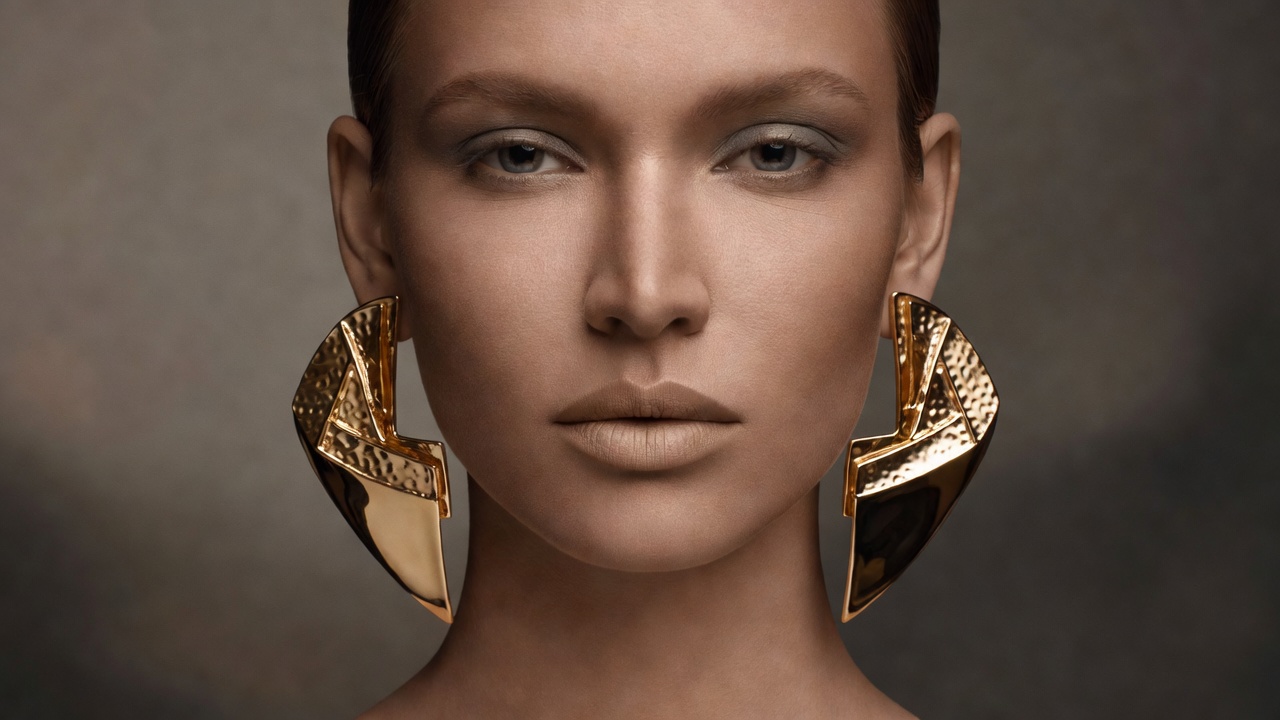
Sculptural earrings
Ask for a bare or softly defined eye and a neutral lip. Hair pulled back keeps the frame open.
Bold neckline
A high ruffled collar or a dramatic cowl is already near the face; skin and eyes in a supporting role keep it from feeling crowded.
Distance and proximity
Focal points close to the face interact more strongly with makeup than those far away. A bright shoe and a bright lip can coexist easily because the eye experiences them separately, with the body in between acting as a pause. A bright collar and a bright lip are neighbours and will either harmonise or argue.
This is why some of the most striking looks place the clothing focus low — a bold skirt, a patterned trouser — and the makeup focus high. The figure gets two clear chapters instead of one crowded paragraph. It is also why a statement scarf often pairs best with a softer face: it occupies the same visual neighbourhood.
Supporting roles matter
Choosing a focal point does not mean neglecting everything else. Supporting elements set the tone the focus is heard in. A red lip feels different with groomed brows and even skin than with deliberately undone hair and a smudged eye; both are valid, and both have the same lead. The supporting cast decides whether the story is polished, relaxed, romantic or sharp.
The same applies to clothing. A dramatic earring with a tailored blazer reads differently from the same earring with a slouchy knit. Neither is better. They are two sentences built around the same noun.
A practical check
Take a phone photo of your finished look, full-length and from a little distance. Look at it for two seconds, then close your eyes. What do you remember first? If it is the element you intended, the focus is working. If it is something you hardly noticed choosing — a busy bag, a shiny forehead, a pattern you forgot about — adjust that element, not the whole look.
Next essay: Adapt Without Starting Again.