Shine Beside Texture
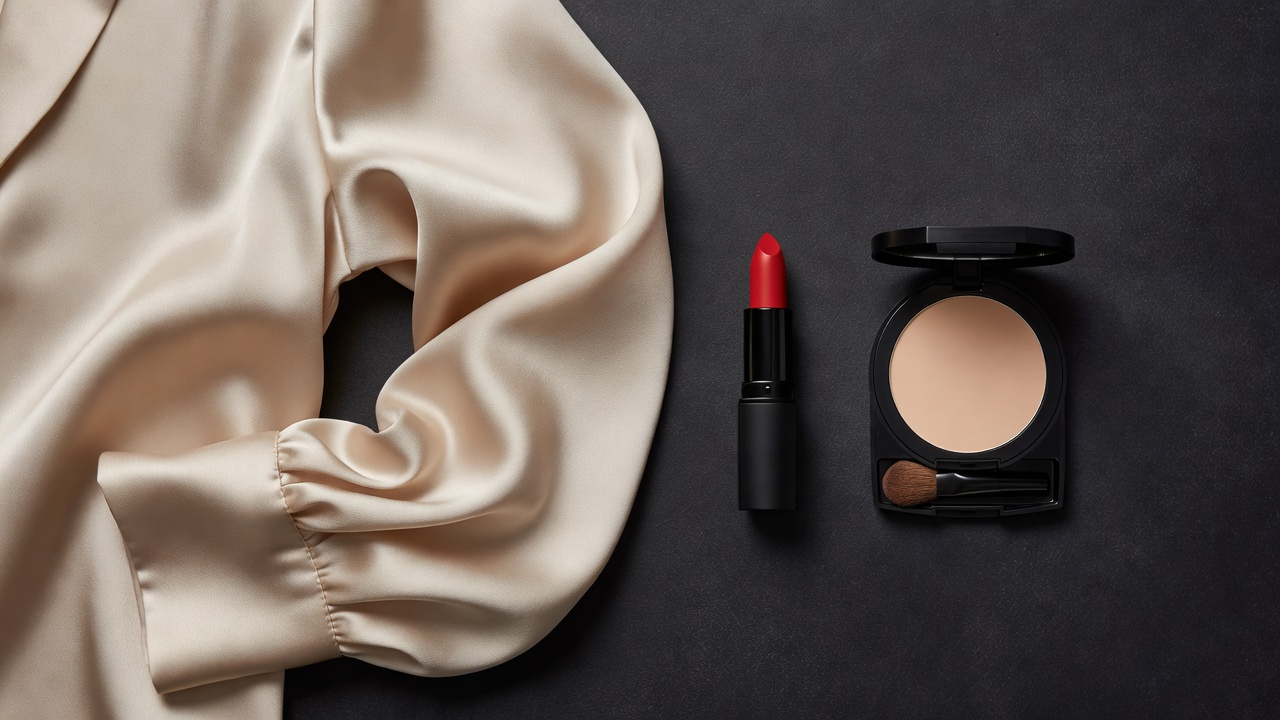
Two looks in identical colours can feel completely different because of finish alone. Gloss, matte, satin and metallic on the face behave like silk, wool, leather and sequins on the body.
Light is part of the outfit
Every surface does something with light. A matte surface scatters it, so colour looks dense and even. A glossy surface reflects it, so colour looks deeper in some places and almost white in others. Satin sits between, giving a soft sheen that moves as you move. Metallics reflect with a coloured cast, which is why gold and silver can feel warmer or cooler than the hues around them.
Fabric follows the same physics. Wool flannel and cotton jersey are largely matte. Silk charmeuse and duchess satin reflect strongly. Leather sits between, depending on how it has been finished. Sequins and lamé are deliberately reflective. When makeup and clothing are read together, these finishes either harmonise or contrast, exactly as colours do.
Shine is attention. Decide where you want it before you decide how much.
Four comparisons
Here are four pairings, each with the same basic colour story, to show how finish alone changes the reading.
- Face
- Glossy cherry lip, bare-looking skin
- Clothes
- Matte grey cashmere crewneck
- Reading
- The lip is the only shine in the frame, so it reads as a highlight and a decision.
- Face
- Velvet-matte cherry lip, soft matte skin
- Clothes
- Cherry silk satin slip dress
- Reading
- The fabric carries the light, the face holds steady. Composed and evening-ready.
- Face
- Satin lip, dewy cheekbones
- Clothes
- Polished black leather jacket, white tee
- Reading
- Mid-level sheen in both places. Coherent, a little cool, easy to wear all day.
- Face
- Gloss lip, metallic lid
- Clothes
- Silver sequinned top
- Reading
- Maximum reflection everywhere. Festive and intentional — or crowded if no area rests.
None of these is wrong. The final pairing works beautifully for a party where reflection is the point. The question is always whether the amount of shine matches the idea you started with.
A short history of finish
Finishes move in and out of fashion as much as colours do. The lacquered reds of the 1950s, seen in campaigns like Revlon's "Fire and Ice", sat comfortably beside structured satins and taffetas. In 1966 Yves Saint Laurent introduced Le Smoking, a tuxedo for women traditionally cut in black wool grain de poudre with satin lapels; in that one garment, matte and shine already share the stage, and a matching tension on the face — a polished lip with a matte complexion — tends to feel at home.
The late makeup artist Kevyn Aucoin, in his 1997 book Making Faces, presented looks that ranged from sheer and luminous to deliberately graphic, showing how the same face could carry radically different finishes. In the 2010s, the "glass skin" ideal associated with Korean skincare culture made high-shine complexions widely popular, and many stylists balanced it with matte, structured knitwear or crisp cotton.
The pattern is consistent across decades: when one surface becomes very reflective, a contrasting surface nearby keeps the look legible.
Texture on the skin, texture on the body
Finish is not only shine. Powder can make skin look soft-focus, like brushed cotton. Cream products look closer to skin's own texture, like fine jersey. Heavy, visible coverage reads structured, like a tailored coat. A useful habit is to describe your fabric first — crisp, fluid, nubby, smooth — and ask whether the face should agree or offer relief.
A chunky, textured fisherman knit often looks good with a fresh, slightly luminous complexion because the knit already supplies visual texture. A sleek silk blouse can accept more defined, graphic makeup because the fabric itself stays quiet in pattern. Tweed, with its flecks and multiple tones, pairs naturally with diffuse, blended colour rather than hard edges.
Our working rule: let one surface lead, let one surface rest, and let everything else take a side.
— Grove Wooden Carousl editorial note
Try this
Choose an outfit and identify its shiniest element: a satin collar, a patent shoe, a metal buckle. Then decide whether your face should echo that shine in a small way — a dab of gloss, a sheen on the cheekbone — or keep it company with matte calm. Look at both versions in a full-length mirror. The one that makes the whole outfit look intentional is the one that fits today.
Next essay: Give the Look a Focal Point.